
How to Store a Mattress So It Isn’t Ruined
A mattress can be ruined in storage by two pieces of advice you’ll read everywhere — sealed plastic wrap and a garage. Here’s how we clean, cover and store mattresses for customers across West Sussex so they come back the way they went in.
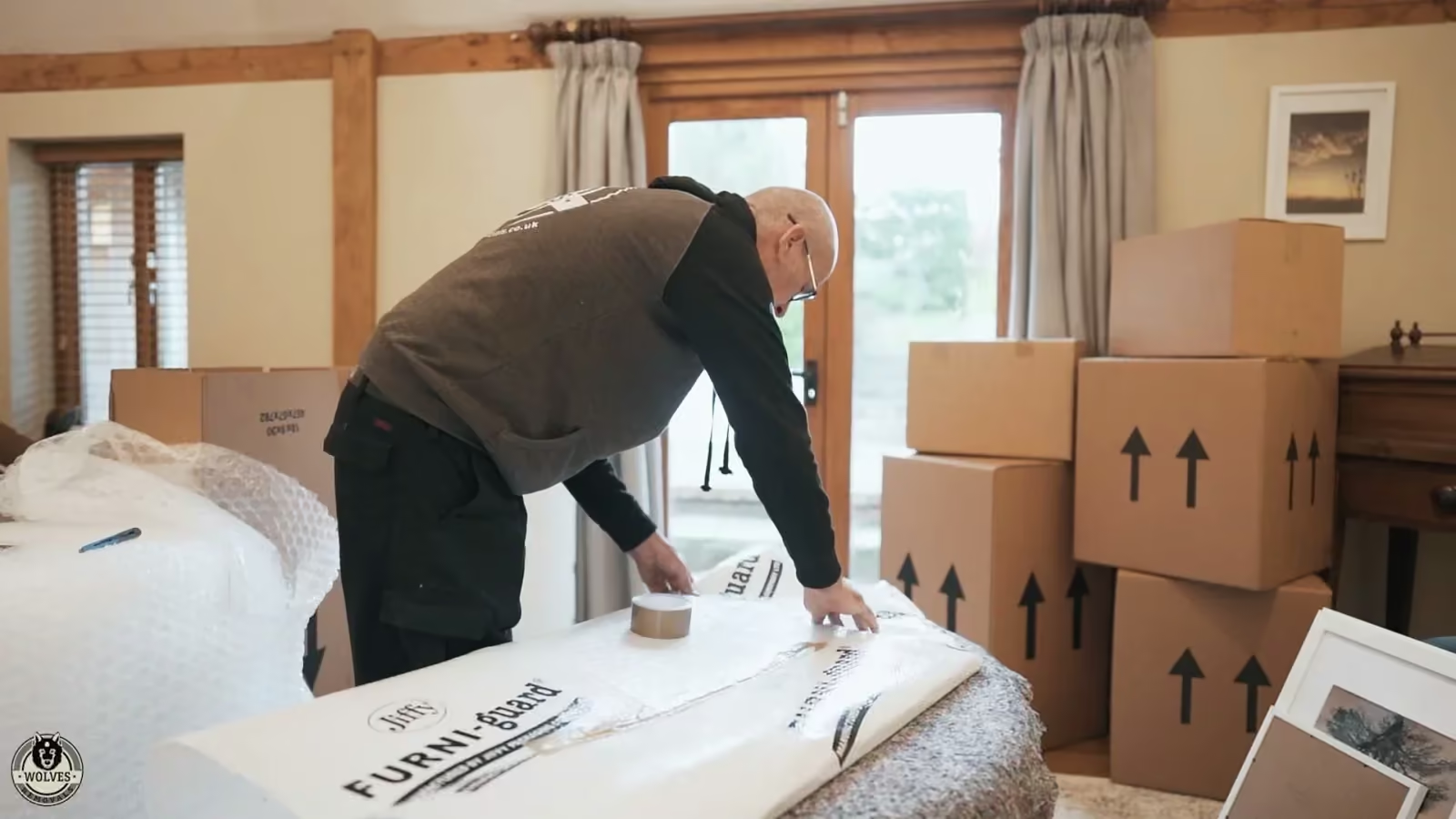
A mattress survives long-term storage without mould, sagging or dents when it’s cleaned and fully dried, stored flat with a breathable cover, and kept in a dry, stable space off the floor. The two things that ruin a mattress fastest are sealed plastic wrap and a garage or loft. Get any one of those wrong and it usually shows within weeks, not years.
We collect and store mattresses across West Sussex as part of full house moves, downsizes and chain-break gaps between completions, and the ones that come back in good condition all have the same few things in common. If you’re storing a mattress alongside the rest of a house move, our furniture storage service covers the wider job — this guide is specifically about getting the mattress itself right, because it’s the item we see go wrong most often.
How do you clean and dry a mattress before storing it?
A mattress should be vacuumed on both sides, spot-treated for any marks, and left fully dry for at least a day or two before it goes anywhere near a storage container, because any residual damp or spilt liquid left inside the fibres will breed mould and draw in pests once the mattress is packed away out of sight. Wash any removable cover separately, use a mild upholstery cleaner rather than soaking the fabric, and open a window or run a fan in the room to speed up evaporation.
Do this a few days before your collection date, not the morning of — a mattress that feels dry to the touch on the surface can still be damp deeper inside the fillings, and that’s the moisture that turns into mould once it’s sealed inside a cover in the dark. For the general rules on wrapping and prepping the rest of your furniture, our guide on how to pack furniture for storage covers that ground — this one stays focused on the mattress itself.
Should a mattress be stored flat or on its side?
A mattress kept flat for the whole time it’s in storage holds its shape properly, while one stood on its side for weeks or months lets gravity pull the springs and foam fillings gradually out of true, leaving a permanent dip, bulge or lean that no amount of turning will correct afterwards. This one catches people out because standing a mattress on its side seems like the obvious way to save space — it’s the opposite of what actually protects it.
Support it along its full length rather than balancing it on an edge, and never stack heavy boxes or furniture on top of it — that compresses the fillings unevenly and leaves dents that are just as permanent as the ones caused by standing it up.
- Clean it — vacuum both sides and treat any marks; anything left on the fabric feeds mould once it’s sealed away.
- Dry it fully — give it 24–48 hours after cleaning before it goes into storage.
- Cover it — a breathable, fitted mattress cover, not sealed polythene sheeting.
- Support it flat — laid on its full length, not balanced on its side or propped against a wall.
- Raise it off the floor — a pallet or boards, kept away from external walls.
Should you wrap a mattress in plastic before storing it?
A mattress wrapped tightly in heavy-duty polythene has whatever moisture is already inside it trapped against the fabric, and because a mattress can’t breathe through sealed plastic, that trapped moisture condenses and turns into mould within weeks — especially across a change of season. This is one of the most repeated pieces of mattress storage advice online, and it’s wrong for anything beyond a short move across town on a wet day.
A breathable, fitted mattress storage bag does the job properly — it keeps dust and light off the mattress while still letting air move through the fabric. If a mattress is going to be stored for more than a few months, it’s worth airing it periodically: unzip the cover, let the room air move over it for an hour or two, then re-cover it. It takes a few minutes and it’s the difference between a mattress that comes out fine and one that doesn’t.
Here are the four pieces of mattress-storage advice that most often backfire — and what actually protects a mattress instead:
| What you’ll often read | Why it’s wrong | What actually protects a mattress |
|---|---|---|
| Wrap it tightly in plastic sheeting | Traps moisture against the fabric and breeds mould within weeks | Use a breathable, fitted cover and air it periodically |
| Store it in the garage or loft | Both swing between damp and dry across the seasons | Keep it in a dry, stable indoor space |
| Stand it on its side to save space | Long spells on-side let springs and foam settle out of shape | Store it flat, supported along its full length |
| Any “climate-controlled” unit will do | Not every unit sold as one is actually monitored or air-conditioned | Keep it in a dry, ventilated, managed indoor warehouse |
Where’s the worst place to store a mattress?
A garage or loft is the worst place in the house to store a mattress, because both spaces swing between damp and near-freezing in winter and stuffy heat in summer, and that seasonal swing is exactly the condition that grows mould and breaks down foam and spring components over time. We’ve written in more detail about the condensation and dew-point science behind this in why furniture struggles through a Sussex winter — the same physics applies to a mattress, only faster, because of how much air a mattress fabric holds against a cold surface.
The mattresses that come back to us in the best condition are the boring ones — cleaned, dried, stood flat, wrapped in something that breathes. The ones that arrive with a grey-green bloom across one side have almost always spent a winter in a garage.Wolves Storage Sussex, on collection day
How long can a mattress be stored for?
A properly prepared mattress — clean, fully dry, flat, breathably covered, in a dry stable space — can typically be stored for several months or even a couple of years without issue, though foam mattresses are more sensitive to time and damp than pocket-sprung ones and benefit from being aired every few months on a longer stay. Short chain-break gaps of a few weeks need the same prep but carry far less risk simply because there’s less time for anything to go wrong.
If you know a mattress is going into storage for the long haul rather than a few weeks between completions, our long-term storage service is built around exactly that — flexible weekly terms with no minimum stay, so you’re not locked into a contract sized for a house move when you actually need somewhere for a year or more.
How do you collect and store a mattress?
A mattress goes into its own sealed, private wooden container — 250 cubic feet, roughly 5ft × 7ft × 8.6ft — which we collect from your door and keep inside our alarmed, 24/7 CCTV, indoor warehouse in Ashington, dry and ventilated, fully insured, until you need it redelivered on 24 hours’ notice. This is managed storage rather than a self-access unit — you don’t drive out and unlock a roller door yourself, we handle the collection and redelivery at both ends.
To be straightforward about what that means: it’s a dry, stable, managed indoor environment, not an actively monitored, air-conditioned climate vault — and for a mattress, that distinction matters less than you’d think. What actually protects a mattress is staying clean, dry and away from the damp-cold swing of a garage or loft, which is exactly what an indoor, dry, ventilated warehouse gives it, without needing anyone to promise something we don’t actively run.
How much does it cost to store a mattress in Sussex?
Container storage with us starts from £21 a week, with no deposit and flexible weekly terms, and a single 250 cu ft container is usually enough space for a mattress plus a good amount of other furniture from the same room or move. Full current pricing and container sizes are on our pricing page.
If you’d like us to collect and store a mattress as part of a move, a chain-break gap or a spare-room clearout anywhere in West Sussex, get in touch and we’ll arrange collection and give you a straightforward quote.
Frequently Asked Questions — The right way to store a mattress
The questions West Sussex customers ask us most.
A spare room works far better than a loft for storing a mattress, because a loft swings through the same damp-then-hot seasonal cycle as a garage, while a spare room stays close to a stable, ventilated indoor temperature all year. A loft is only worth using if it’s boarded, insulated and properly ventilated — most aren’t.
Memory foam needs the same core rules as a pocket-sprung mattress — clean, fully dry, flat, breathable cover, dry stable space — but it’s more sensitive to damp because foam holds moisture inside its cell structure rather than letting it pass through, so it takes longer to dry out and mould can develop deeper inside before it’s visible on the surface.
Most mattress warranties are voided by damage, staining or mould rather than by storage itself, so a mattress stored clean, dry, flat and uncompressed shouldn’t breach the terms — it’s worth checking your specific manufacturer’s wording, since a small number exclude any period spent outside daily use.
A standard spring or foam mattress should never be rolled or folded for storage, because that permanently damages the internal structure — rolling is only appropriate for mattresses specifically designed and sold as roll-up or vacuum-packed products, which say so on the label.
A mattress left uncovered for a few weeks in a genuinely clean, dry, dust-free space will usually be fine, but a breathable cover costs very little and protects against dust, light staining and any stray damp in the meantime — it’s cheap insurance for a short stay and essential for anything longer.
A mouldy mattress usually shows as dark grey, green or black patches, often on the underside or along a seam, paired with a musty smell that doesn’t air out after a few hours outside — once mould has set into the internal fillings rather than just the surface fabric, the mattress needs replacing rather than cleaning.
Still have a question? Talk to the family team

Store Without Lifting a Finger — The right way to store a mattress
Storage from just £21 a week with no deposit — collection and redelivery quoted separately, upfront. Free, no-obligation quote within 24 hours.
We’re Trusted By