
Moving to Haywards Heath: A Local Guide
Haywards Heath offers something none of the other towns in this series can: a fast run to Brighton in one direction and a fast run into London in the other, from a station junction that built the town around it in 1841. This guide covers what each pocket of RH16–RH17 is like to live in, and the groundwork a move here needs that rarely makes it onto a property listing.
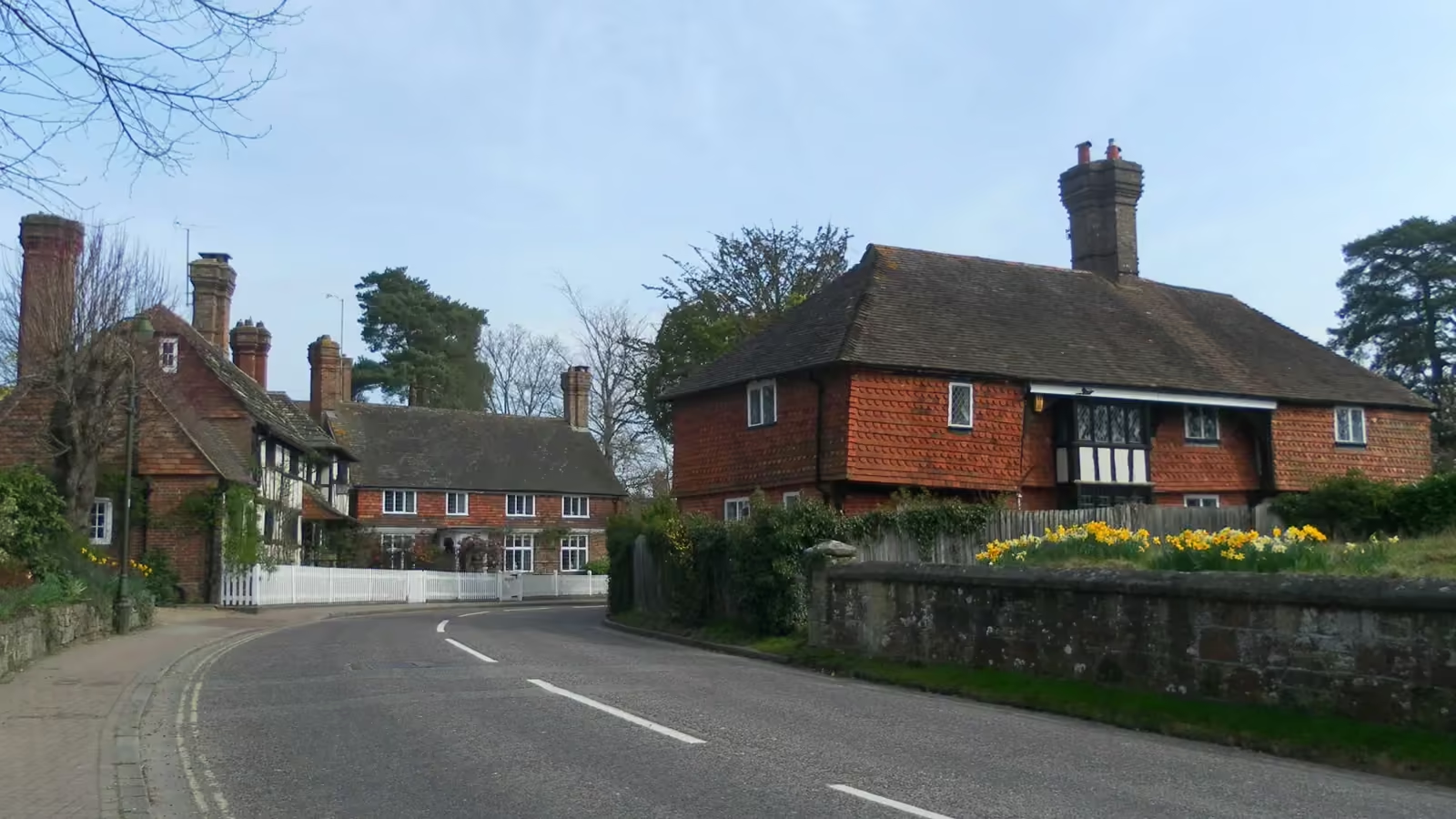
Haywards Heath does something none of the other towns in this series can: turn one way at the station and you’re in Brighton inside half an hour, turn the other and you’re in central London within the hour. It’s the main seat of Mid Sussex district, built around the Broadway and the platforms that made it, with Lindfield’s older village life a mile up the road. Here’s what each pocket of RH16–RH17 is actually like to live in, and the groundwork a move here needs that rarely makes it onto a property listing.
Haywards Heath didn’t grow around a market square the way Cuckfield or Lindfield did — it grew around a railway junction. The London & Brighton Railway opened a station here on 12 July 1841, on what was then open heathland between the two older villages, and the settlement that grew up around the tracks soon outgrew both of them; Cuckfield’s coaching trade fell away once through-traffic switched to the new line. The town is now Mid Sussex district’s main seat, with a recorded population of 33,845 at the 2011 census and thousands more added since through developments like Bolnore Village. RH16 covers the town itself, RH17 the villages and hamlets around it.
The neighbourhoods of Haywards Heath, town centre to village edge
Haywards Heath runs from the RH16 streets packed tight around the station out to the RH17 villages of Lindfield and Cuckfield beyond the by-pass. Here is how each pocket actually lives — and how close it really sits to a platform.
| Area | Typical homes | Who it suits | Commute & character |
|---|---|---|---|
| Town centre & the Broadway (RH16) | Victorian and Edwardian terraces and flats above the shops around the station, the Broadway and South Road | Buyers and renters wanting both platforms — Brighton and London — within a few minutes’ walk | The shortest possible walk to the fastest services in either direction; the busiest, most built-up part of town |
| Fox Hill | Larger detached houses and bungalows on higher ground south of the centre | Buyers wanting more garden and a quieter road while staying within walking distance of the station | A longer, gently uphill walk to the platform rather than a flat one; noticeably quieter than the streets nearer the Broadway |
| Bolnore Village | 2000s–2010s new-build estate housing from an original 780-home masterplan, with its own primary school and shopping parade | Families wanting modern layouts and off-street parking without leaving Haywards Heath | A drive or bus into the centre rather than a walk to the platform; the town’s first purpose-built modern neighbourhood |
| Sandrocks | The newest housing in town, built out in phases south of the A272 as Bolnore Village’s construction wound down | Buyers wanting the most recently built stock available, even at the cost of a longer run to the station | Furthest of these areas from the platforms; closer to the A272 than to a train |
| Franklands & Ashenground | 1930s Franklands Village — originally built as smallholdings to help low-income families become self-sufficient — alongside later housing around Ashenground Wood | Buyers wanting an established, lower-cost part of town with woodland close by rather than a modern estate | West of the relief road and further from the centre than Fox Hill, with Ashenground’s nature reserve on the doorstep |
| Lindfield (village) | Period cottages and townhouses along the historic High Street — over forty medieval and post-medieval timber-framed buildings — plus later infill closer to the by-pass | Buyers wanting village life and a duck pond over a commuter-town centre | A drive, bus or a longer walk into Haywards Heath station; High Street frontages sit inside a conservation area with tighter rules on exterior changes |
| Cuckfield | Elizabethan and Georgian cottages around the old High Street and the 13th-century Holy Trinity Church | Buyers wanting the most historic core nearby, and happy to drive to the train | No station of its own — the railway bypassed Cuckfield for Haywards Heath in the 1840s, which is why one grew and the other didn’t |
The pull that shapes a Haywards Heath move
Everything else here is detail. The one fact that decides more Haywards Heath moves than any other is the direction of the platform — a genuine two-way pull that most Sussex commuter towns can only offer one side of.
Sussex trains run south from Haywards Heath to Brighton in around 22 minutes on a typical service, 14 at the fastest; north, London Victoria takes about 59 minutes typically (43 at the fastest), and London Bridge about 54 minutes (44 at the fastest — Trainline). Few stations on this line offer a genuinely fast run both ways at once; most Sussex commuter towns pick a side.
On price, Rightmove’s recent sold-price data puts the average Haywards Heath home at around £450,250 over the past year — flats average around £255,500, semi-detached houses around £487,700, and detached houses around £735,600. That’s a clear Mid Sussex commuter-belt premium, sitting well above nearby Burgess Hill and reflecting the extra pull of the faster London trains.
Away from the station, Beech Hurst Gardens and Victoria Park carry most of the town’s everyday green space — the latter hosting Haywards Heath’s Town Day each September — while the Broadway and the Orchards shopping centre handle the day-to-day shopping the station forecourt was never built for. Schools sit across the town and its surrounding villages rather than in one cluster; confirm current catchment for a specific street with West Sussex County Council before you commit.
Haywards Heath vs Burgess Hill
Both towns sit on the same railway line, in the same district, and both grew around stations that opened in 1841 — but they don’t offer the same thing to a buyer.
| Metric | Haywards Heath | Burgess Hill |
|---|---|---|
| Average house price | Around £450,250 | Around £411,960 |
| Typical train to London Victoria | About 59 minutes (43 at the fastest) | About 1hr 4 (50 at the fastest) |
| Character | Older Victorian core plus newer estates, with historic Lindfield and Cuckfield on its doorstep | A younger-feeling centre shaped by a mid-20th-century growth boom, alongside its own Victorian pockets |
Burgess Hill is the cheaper of the two and sits on the same line into London, so the saving is real for anyone happy to add a few extra minutes to the commute. Haywards Heath costs more but buys a faster run to Victoria, the pull toward Brighton as well, and a wider spread of housing ages within a short drive — from Bolnore’s new-build streets to Lindfield’s timber-framed High Street.
What catches people out about moving to Haywards Heath
None of this shows up on a property listing, but it shapes how a Haywards Heath move actually goes.
A ‘typical Haywards Heath house’ barely exists as a single idea. A bay-fronted Victorian terrace near the Broadway, a four-bed on Bolnore Village and a beamed cottage on Lindfield High Street are all sold as Haywards Heath homes, and they don’t compare like for like on room sizes, parking or upkeep. Measure the property you’re actually buying against your furniture, rather than assuming a bedroom count means the same thing on every street in town.
Two councils run different halves of a Haywards Heath move, and it’s easy to ring the wrong one. Mid Sussex District Council handles council tax, bins and planning permission for the town and its surrounding villages, while West Sussex County Council runs schools, libraries and the roads — separate organisations with separate phone numbers. Working out which does what before moving week saves a wasted call in the middle of it.
Moving in near Lindfield’s High Street brings planning rules a Bolnore semi doesn’t have. The High Street’s forty-plus timber-framed houses sit within a conservation area, where exterior changes — a new window, a repainted shopfront, even some types of fencing — can need planning consent that wouldn’t apply a mile away on a newer estate. Check with Mid Sussex District Council’s planning team before you commit to any changes, not after.
The two-way commute means rush hour doesn’t run in just one direction. Because Haywards Heath sends commuters toward Brighton as well as London, the station approach and the roads into town don’t have one obvious quiet window — worth checking a removal firm’s suggested arrival slot against traffic heading both ways, rather than assuming a mid-morning slot is automatically clear.
A fast-moving commuter market doesn’t always keep completion dates lined up. It’s common enough locally to complete on a sale before the next purchase is ready, particularly when a chain runs through Brighton or London as well as Sussex. A managed storage service in Haywards Heath can collect from the old address and hold everything safely until the new one’s ready, rather than living out of a car boot for a fortnight.
Your Haywards Heath moving-week admin
The paperwork that’s easiest to lose track of once the boxes are packed, gathered in one place:
- Tell the council you’re moving — report your change of address for council tax via Mid Sussex District Council’s moving home page, and register separately for the electoral roll.
- Note which council does what — Mid Sussex District Council covers council tax, bins and planning; West Sussex County Council runs schools, libraries and the roads. Save yourself a call to the wrong office.
- Redirect your post with Royal Mail, and update your address with your bank, DVLA, GP and any subscriptions.
- Take meter readings at both properties and get your new utility accounts set up.
- Apply for school places in good time via West Sussex County Council’s school places page if you’re moving with children.
- Check conservation-area rules before planning any exterior work if you’re moving in near Lindfield’s High Street.
Frequently Asked Questions — Moving to Haywards Heath: A Local Guide
The questions West Sussex customers ask us most.
For commuters who can’t decide between Brighton and London, it’s hard to beat — fast trains run comfortably in both directions from one station, and the town has its own centre, park and shops rather than functioning purely as a dormitory for somewhere else. It suits people who want a working commuter town with village neighbours close by, rather than a seafront or a historic centre of its own.
Yes. Rightmove’s recent sold-price data puts the average Haywards Heath home at around £450,250 against roughly £411,960 in Burgess Hill — a gap of around 9%, which broadly tracks with Haywards Heath’s faster train into Victoria.
Bolnore Village is the usual pick for families wanting a modern layout, off-street parking and a primary school within the estate; Fox Hill suits those who’d rather have more garden on an established road within walking distance of the centre.
Trains run to Brighton in around 22 minutes on a typical service (14 at the fastest), and to London Victoria in around 59 minutes typically (43 at the fastest) — or London Bridge in about 54 minutes typically (44 at the fastest). Few Sussex commuter towns offer a genuinely fast run in both directions from the same station.
Yes, for council tax and planning — both sit within Mid Sussex District Council, whose main offices are in Haywards Heath itself. Schools, libraries and roads are handled separately by West Sussex County Council, which covers a much wider area than the district.
Lindfield, a mile or so from the town centre, has the densest run of period housing in the area — over forty medieval and post-medieval timber-framed houses along its High Street, many within a conservation area. Cuckfield, a little further out, has an even older core but no station of its own, so it suits buyers happy to drive to the train.
Still have a question? Talk to the family team

Store Without Lifting a Finger — Moving to Haywards Heath: A Local Guide
Storage from just £21 a week with no deposit — collection and redelivery quoted separately, upfront. Free, no-obligation quote within 24 hours.
We’re Trusted By